

A guide comparing the main types of French immersion programs for adults in France, intensive language schools, homestay immersion, and private one-to-one tutoring, with advice on what to look for, cultural activities included, and how to register.
So you’ve decided it’s time to finally speak French. Not just read it, not just recognize it in a song, but actually speak it, with confidence, in real conversations. Total immersion is exactly the kind of method that gets you there. If you want to genuinely learn French in France, there’s no shortcut quite like it, surrounded by the language from the moment you open your eyes to the moment you fall asleep.
But “immersion in France” can mean very different things depending on the program you choose. A crowded language school in a resort town is not the same experience as spending a quiet week with a private tutor who adapts every lesson to you. Before you book anything, it’s worth understanding what your options really are, and which one actually fits an adult learner who wants to make real progress, not just collect a certificate.
Whether you’re a recently retired professional finally making time for a long-held dream, or simply someone in their 30s or 40s carving out a week between work commitments, the same question comes up: which kind of program will actually get you speaking? This guide walks you through what total immersion really means, the main types of adult French courses available in France today, and how to choose the program that will get you there with genuine confidence. For a broader look at how our own French immersion programs are structured, that’s a good companion read alongside this one.
What is Total Immersion in French?
Total immersion isn’t a marketing term, it’s a specific way of learning. Instead of attending a French class for an hour or two and then going back to your everyday life in English, you spend entire days living inside the language: lessons in the morning, conversation over lunch, a walk through the market in the afternoon, dinner conversation in the evening, all in French.
This kind of language learning works because it mirrors how we actually acquired our first language as children, through repetition, context, and necessity, not through memorized rules. Traditional classroom learning teaches you grammar; intensive French immersion teaches you to think and react in French. It’s the difference between knowing the theory of swimming and actually being in the water, and it’s simply the fastest way to improve your French.
For adults especially, this approach is remarkably effective. It compresses months of gradual classroom progress into a single, focused week or two, and it does so in a way that feels far more natural than working through grammar exercises on paper, book in hand, with no one to actually speak to.
But the real value of immersion goes beyond speed. Ask anyone who has spent years studying French in a classroom what happened the first time they actually landed in France, and you’ll often hear the same story: the arrival is brutal. The French people speak in real life turns out to be barely recognizable next to the French of the textbook. Ordering at a boulangerie, catching a rapid exchange between friends, following the contractions and shortcuts everyone uses without thinking, none of it matches what was studied for years. That gap between “school French” and everyday French is exactly what total immersion closes, because you’re not translating textbook French into real life, you’re learning the real thing from day one.
What are the Options for Adult French Courses?
If you start researching immersion in France, you’ll quickly discover there’s no single definition of the word. It can mean a full-time language school, a residential program with a small group of students, a private tutor who spends the week with you, whether that means staying under their roof or simply spending your days together while you keep a place of your own, or something in between, and each version offers a genuinely different experience.
Intensive French Language Schools
The most well-known option is the traditional language school. Several established institutions run intensive language courses for adults, often with classes running from Monday to Friday, mixing morning grammar and vocabulary work with afternoon conversation practice. The Alliance Française, with well-known centers in Paris and Nice, is probably the most recognized name in this category. The Institut de Français, based in Villefranche-sur-Mer, is another long-standing french immersion school, alongside other institutions set in genuinely stunning locations across the south of France and the French Riviera, with programs framed around 8 or more hours of instruction per day for two to four weeks.

For all their reputation, these schools come with real limitations for an adult learner who wants to actually speak:
- Less speaking time than you’d think. Once a class goes beyond one or two students, actual speaking time per person drops fast, and learning to speak requires speaking.
- Less corrective feedback. In a group of four or five, it also becomes far harder for a teacher to give corrective feedback after each attempt, let alone keep a written record of every correction for you to review later.
- Conversation topics that don’t match daily life. Textbooks and teaching methods tend to steer conversation toward set themes: the environment, social media, current affairs. Useful, but a step removed from the reactions, personal stories, and idiomatic expressions that actually make up everyday spoken French.
- What’s usually missing too is guided, hands-on practice: actually being walked through a real bakery, market stall, or restaurant, until you can handle it confidently on your own.
- A more formal, written French. In the vast majority of cases, the French taught in these schools is a correct, formal French, closer to the written language than to how French people actually speak.
- A mixed group with mixed struggles. Students arrive from every part of the world, and a Korean student, a Latin American student, and an American student don’t run into the same difficulties at all, yet they often sit through the exact same lesson.
Homestay Immersion with a Host Teacher

Beyond the schools, the more personal formats on offer aren’t all the same shape, and homestay is only one of them. Sleeping under someone else’s roof, however welcoming, can feel overwhelming for some adults, and that really comes down to the person. On Immersion French, the focus isn’t on joining a host family so much as on having a teacher as your guide for the week, sometimes with family around, sometimes not, without that guide ever crowding your own space. Many of the teachers you’ll find elsewhere lean heavily on the family homestay model; here, the emphasis sits more with the teacher themselves, and having a guide who doesn’t encroach on your privacy is, for a lot of students, genuinely one of the most comfortable parts of the week. Students can choose between two formulas.
The first is living in your teacher’s own home: a room in their house or in accommodation close by, sharing meals, errands, and daily life together. It’s an immersion homestay in every sense, warm, spontaneous, and putting you right in the middle of daily French life from breakfast to bedtime, though not necessarily surrounded by a full family: Soline and Françoise, for instance, both welcome students into their own homes, without folding them into a family life around them. This can still take very different forms depending on where your teacher is based: Soline‘s home sits in the countryside, close to nature and far from any classroom, while Françoise‘s is her own Parisian apartment, giving you all of Paris to explore between lessons. Either way, walking out the door means walking straight into your day’s French.

The second, and increasingly popular, formula is a genuinely separate accommodation: your own place, at a distance from your teacher’s home, while still spending your days together for lessons, meals, and outings. This suits adults who’d rather not share someone else’s home, however welcoming, but still want the full experience: real lessons, real excursions, a real French week, just with somewhere entirely their own to come back to. This version keeps all the benefits of full immersion, real conversation, shared meals, cultural outings, while also giving you something a homestay can’t: genuine downtime. A space that’s entirely your own to rest in, read in, or simply decompress in after a full day in French, plus the freedom to step out on your own in the late afternoon or evening and explore the town at your own rhythm before rejoining your teacher the next morning.
Both formulas share the same core advantages:
- True one-to-one attention, with lessons built entirely around your goals and pace
- Constant informal practice, over coffee, while cooking, during a walk, not just structured class time
- A relaxed, low-pressure environment, ideal for adults who feel rusty or self-conscious about speaking
- A genuine relationship with your teacher, who gets to know your strengths and sticking points over the course of the stay
- Full cultural immersion, since you’re living daily life in France rather than moving between a classroom and a hotel
- A written record of everything you learn, since teachers keep notes in a shared Google Doc throughout the week, both during lessons and during the more informal moments (a market visit, a dinner conversation, a new expression that comes up over coffee). That way you can stay focused on speaking in the moment, without worrying about writing everything down, and go back through it all later to review.
Which formula is right for you comes down to what kind of week you want. If you’re happy sharing daily life with your teacher and don’t mind being folded into their rhythm, the homestay is wonderful. If you want the depth of immersion with a private space to retreat to and time to explore on your own terms, the separate accommodation formula is often the more comfortable, more premium choice, especially for adults who value their independence.
What to Look for in a Recommended French Immersion Program
Beyond intensive schools and private, one-to-one teachers, you’ll also come across boutique residential programs like Millefeuille Provence in the Rhône Valley, or Coeur de France Ecole de Langue in the wine town of Sancerre that sit somewhere in between: still group-based, usually welcoming four or more students at once around shared meals and outings, but on a smaller scale than a full language school. They can be a pleasant middle ground, but by definition they’re still a group course, and a group course simply can’t offer the same one-to-one attention, whatever its size.
What actually defines a recommended French immersion program for an adult learner comes down to a short list of criteria:
- Group size. How many people are actually sharing your teacher’s attention, ideally just you, or at most two or three people traveling together.
- Your own space. Does the accommodation give you a private space of your own, or does it mean sharing someone else’s home entirely, with everything that involves?
- City or countryside. In the countryside, can you step out on your own in your free time and practice what you’ve learned, or are you dependent on someone else to get around? A rural setting also tends to reveal local habits and sights well off the beaten path. A mid-sized or larger city, on the other hand, is a place where people find it easier to slip into English with you, but it comes with a much richer cultural offer, whether that’s a seaside town built for a proper holiday or a historic city with centuries of things to discover.
This is exactly where a private, one-to-one immersion program stands apart. There’s no class to keep pace with, no shared schedule to accommodate, and no mixed levels diluting your instruction time. With around thirty hours spent directly with your teacher over the course of a week, every hour is built entirely around you: your goals, your pace, your comfort level. Add to that the choice between a homestay and a private, separate accommodation, and you can shape the entire week around exactly how much closeness or independence you want. If you’re specifically looking for a genuinely intensive week on top of that, a teacher like Gwen shows what that looks like in practice: a full, tightly packed schedule of one-to-one lessons, with accommodation right on site, attached to her own home. For adult learners who want the depth of immersion without the pressure of a classroom, this remains the most personalized and effective way to learn French in France.
Beyond the Classroom: What Cultural Activities are Included?
One of the great rewards of French language immersion is that the culture and the language arrive together. A good program doesn’t stop teaching when the lesson ends, it simply moves the lesson outside, combining French language and culture into a single, seamless method rather than treating them as two separate subjects.
Depending on where your program is situated, this might mean a morning at a local market discussing how to choose the right cheese or the season’s best produce, an afternoon walk through a medieval village, or an evening tasting a Bordeaux, a Sancerre, or something from the Rhône Valley, while chatting about the harvest in French. Cooking a meal together, visiting a château, or simply sharing an apéritif with neighbors are all ways to discover culture that go far beyond sightseeing, whether your stay falls in the quiet of spring or the height of summer.
This is where private immersion has a real edge over the summer-camp feel of larger schools: the activities are chosen around your own interests, not built to entertain a crowd. If you love gastronomy, your afternoons can center on food. If history draws you in, your tutor can build outings around it instead. And if you’ve chosen the separate accommodation formula, you’ll also have quiet stretches of free time to wander a market or a village square entirely on your own, putting your new vocabulary to the test at your own pace before rejoining your teacher. The beautiful part of this method is that it never feels like a forced tour, it feels like living, for a week, as a local, and it’s a wonderful place to start if you’ve never experienced deep cultural immersion before.
Can a 60-Year-Old Learn French? Overcoming Age and Level Barriers
Here’s the short answer: absolutely, whether you’re 45 or 85, and often more successfully than younger students, because adult learners bring focus, motivation, and life experience that younger students simply don’t have yet.
Many people considering a French immersion program are above 40 years old, and the most common worry isn’t ability, it’s confidence. “Am I too old to start?” “What if everyone else is better than me?” “Will I feel embarrassed making mistakes in front of a class?” These are completely natural concerns, but they mostly apply to group classroom settings, not to private immersion.
In a one-to-one or small private program, there is no age class to keep up with and no risk of feeling behind. A true beginner can progress easily at their own pace without ever comparing themselves to someone ten years younger with better recall. Language skills at any age improve dramatically once the fear of judgment is removed, and in a private immersion setting, with a patient native teacher giving full attention to just one or two students, that fear tends to disappear within the first day or two. Adults, and seniors in particular, are often surprised by how easily they pick things up once they’re simply given the space to try, and, for those who prefer it, a bit of quiet time to themselves at the end of the day too.
There’s also a good reason to start precisely because of your age, not despite it. Learning a language, like learning to play an instrument, is one of the few activities known to genuinely exercise and strengthen cognitive function later in life, which makes a French immersion week as good for the brain as it is for your travel plans.
How to Register for Your French Immersion Journey
Once you’ve decided that private, one-to-one immersion is the right fit, getting started is straightforward, but it’s worth taking your time with each step. It’s a good idea to check school-style options and independent teacher profiles side by side before you commit, so you know exactly what you’re comparing.
- Browse programs on the homepage, filtering by teacher availability and by the number of students or guests you want to bring along, whether that’s just you, or two or three people traveling together. Since every stay on Immersion French is exclusive, there’s never a group to join, this simply lets you find teachers set up to welcome the number of people you have in mind. Some teachers are booked out six months to a year in advance, so it’s well worth planning ahead rather than waiting for the last minute.
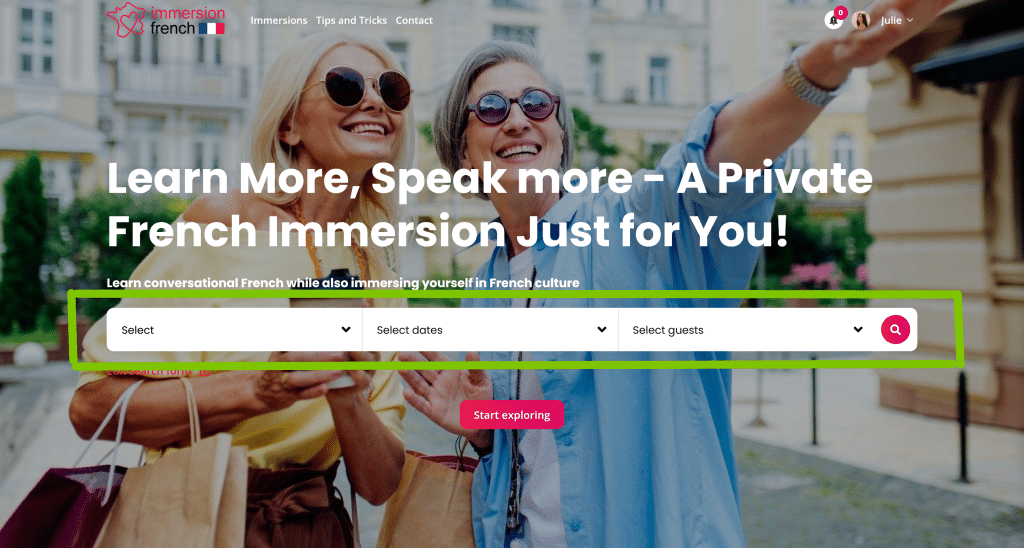
- Or click “Start exploring” to browse teachers directly on a map of France, filtering by location and price to find the region and the budget that suit you.
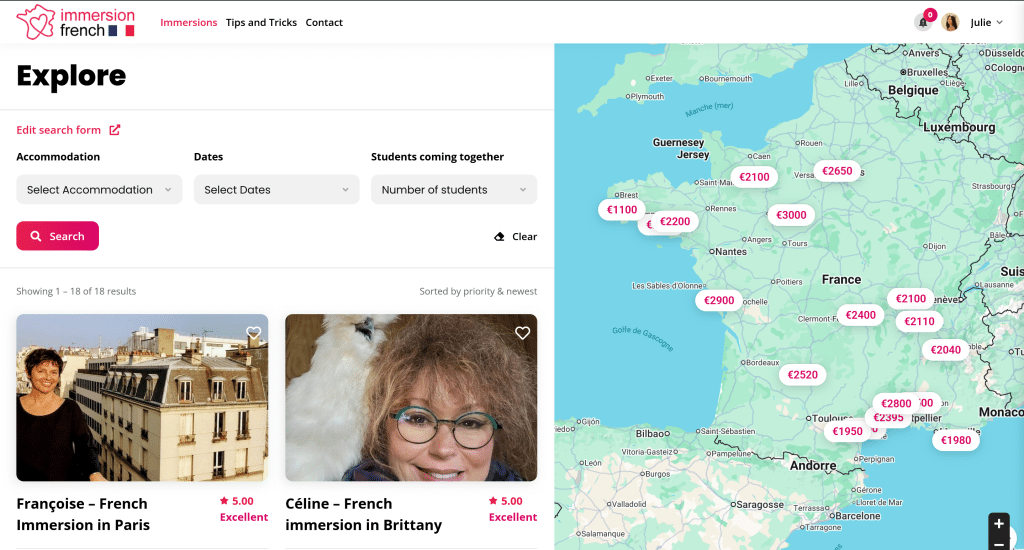
- Read the profiles of any teachers you’re drawn to carefully. Look at the details of the accommodation, whether they’re based in a city or in the countryside (each offers a different kind of experience and different activities), reviews left by previous students, and the teacher’s personality and teaching style, whether that leans more traditional or is built entirely around conversation, depending on what you’re looking for.
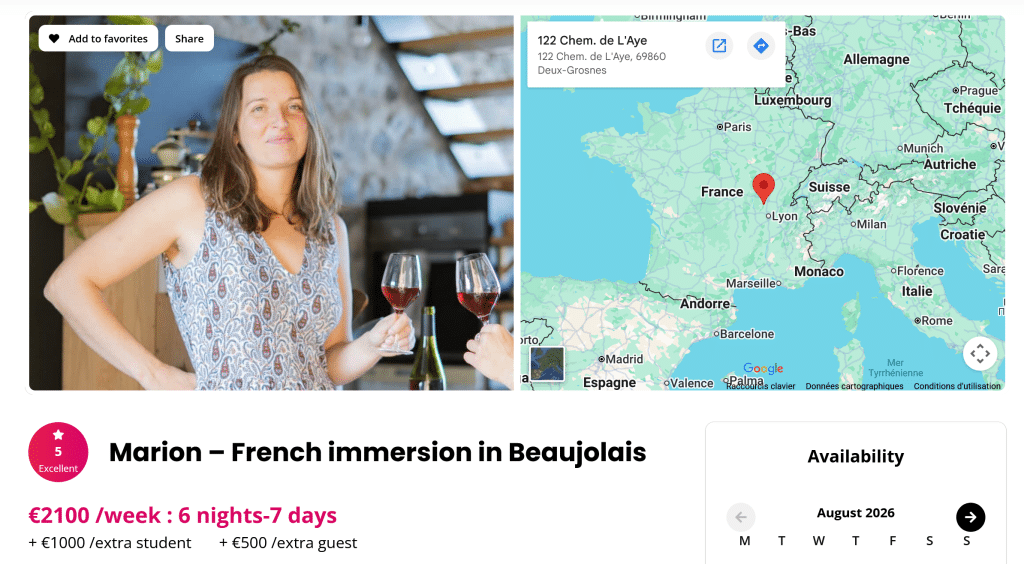
Note that with many teachers, accommodation is offered as an option rather than a fixed package: if you’d rather stay somewhere of your own choosing, you’re free to book separately and simply join your teacher for lessons and activities each day. Edwige, by the ocean in Brittany, works exactly this way, offering an à la carte immersion where you arrange your own accommodation nearby. If you’re not fully certain of your dates yet, it’s also worth checking the cancellation policy: since every teacher is an independent professional, these policies tend to be fairly strict, which protects their business.
- Contact the teacher directly through the form on their profile, and use it to register your interest with real info: your interests, your current level of French, and what you’re hoping to get out of the week, so the teacher can start picturing the tailor-made stay they can offer you. Once you send the form, you’ll receive a recap email confirming your request, and the teacher will then reach out to you directly by email to start the conversation.
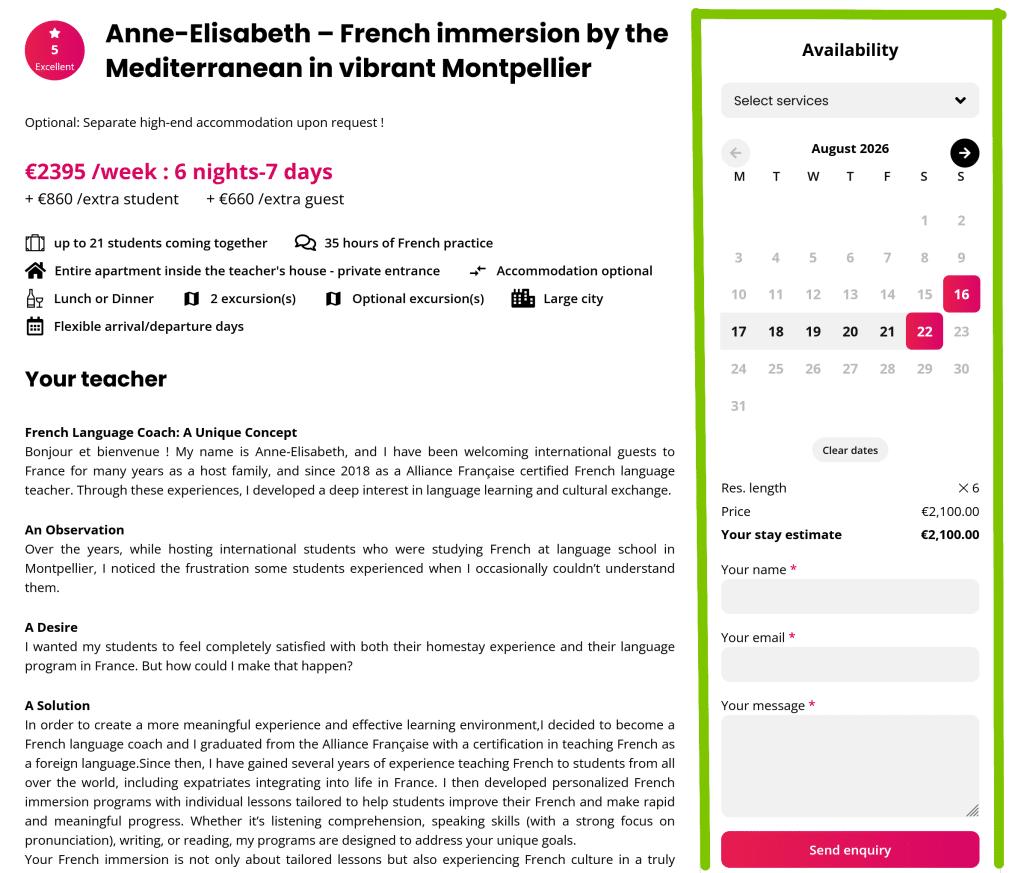
- Ask any question that comes to mind, then sign off on your dates with a first payment to secure them. It’s also worth asking whether the teacher offers a few online lessons beforehand: it’s a great way to get to know each other and prepare the stay as well as possible before you arrive and start your week together, Monday to Friday, with your French teacher.

Ready to experience real French life and make progress fast? Discover our private French immersion programs in France, and start living the language instead of just studying it.