

When people picture a language trip to France, they usually picture July: lavender, long evenings, crowded terraces. Summer has its charm, but it is rarely the best setting for language acquisition. Train stations are busy, museums are packed, prices peak, and a surprising number of French people have left their own towns for the coast. So, what is the best time for French immersion? For most adult learners, the answer is the off-season: autumn (September to November) and spring (March to June).
These are the months when France goes back to its normal rhythm. Locals have time to talk, your teacher is not juggling the summer rush, accommodation is easier to book, and every conversation at the bakery or the market happens in French, with French people, about French life. This guide compares the seasons month by month, weighs summer programs against the off-season, explains what teachers and school groups should know before booking a school trip to France, and shows how to choose a French immersion program for autumn or spring.

What is the Best Time of Year for French Immersion? Season by Season
There is no bad month to learn French in France, but each season gives you a different country. The best time of year for French immersion depends on what you want from the experience: warm weather, cultural events, quiet streets, or simply the most speaking practice per hour. Here is how the calendar looks from a learner’s point of view.
The Magic of Autumn (September to November)
September is the month the whole country starts again. French people call it la rentrée: children go back to school, adults go back to work, new books and films come out, associations restart their activities and town halls publish their autumn programs. For a learner, this is the ideal time for immersion, because you arrive in a country that is busy with its own life rather than with tourists.
The weather helps too. In the South of France, September is often still beautiful enough for swimming, and October brings soft light, vineyards turning red and gold, and comfortable temperatures for walking tours. Further north, in Brittany or Normandy, autumn means markets full of apples, mushrooms and chestnuts, and cozy evenings around a shared dinner, which is where some of the best French conversation happens.
Here is what a typical autumn month offers to someone on an immersion stay:
- September: warm days, the end of the holiday crowds, the grape harvest (les vendanges) in wine regions, and the European Heritage Days on the third weekend of the month, when many monuments and private buildings open their doors to the public. In Nîmes, the Féria des Vendanges fills the streets with music and local traditions.
- October: the heart of the season for wine, chestnuts and mushrooms. Cultural life is in full swing, cafés are full of locals, and the light is perfect for photography. One learner who stayed with our teacher Florence in South Brittany in October wrote that the excursions went “from sandy beaches to medieval castles”, and included gathering mushrooms in the forest.
- November: quieter and cooler, with the lowest prices of the autumn. It is also the month of Beaujolais Nouveau (released on the third Thursday of November) and of Les Trois Glorieuses in Beaune, the famous Burgundy wine weekend. A November stay is a strong choice for learners who want maximum teaching time and minimum distraction.

The experience of immersion in autumn is also about what you hear around you. In September and October, conversations at the café are about the new school year, the harvest, local elections, the latest book prize, or the next long weekend. These are the topics of real French life, and they give you vocabulary you will use for years.
The Revival of Spring (March to June)
Spring is the other ideal window. From March onward, days get longer, markets fill with asparagus, strawberries and early cherries, and the country comes back outside. By June, the light lasts until late in the evening, which leaves plenty of time for activities and excursions after your morning lessons.
- March and April: mild weather in the south, fresh green countryside everywhere else, and very few tourists outside the Easter weekend. In the Alps, March is still a good month for snowshoeing, as one learner discovered during a week with Yasmina near Grenoble.
- May: the month of long weekends. With May 1, May 8, Ascension Day and sometimes Whit Monday, French people “make bridges” (faire le pont), taking an extra day off between a public holiday and the weekend. The ponts de mai are a cultural lesson in themselves and a great conversation topic.
- June: the start of the outdoor season, with the Fête de la Musique on June 21, outdoor concerts, village festivals and terraces in Paris and the South of France filled with local people rather than tour groups. Late June is also when lavender begins to bloom in Provence.
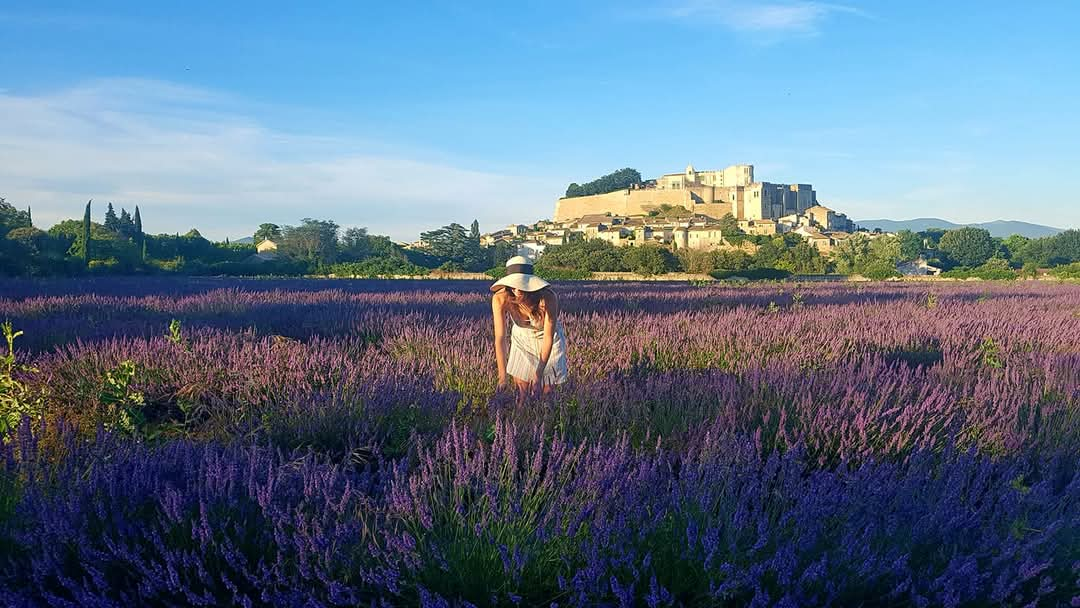
Spring suits learners who want sunshine without heat, and those who like to combine lessons with walking, cycling or garden visits. It also places you in France at a moment of optimism: people are outside, talkative and planning their summer, which makes it easy to start a conversation.
And Winter?
Winter is the quietest season, and it has its own appeal for learners who mostly want intensive one-on-one teaching. December brings Christmas markets in Alsace and the Fête des Lumières in Lyon (around December 8), and February brings the Nice Carnival and the Menton Lemon Festival on the Riviera. If your goal is pure language work with a few cultural outings, a winter week can offer excellent value. Pierre, who hosts students in Languedoc, welcomed one learner in February who praised the way he “seamlessly wove lessons into everyday life”.

Summer Programs vs. Off-Season: A Realistic Comparison
Many learners first search for the best French summer programs, and it is easy to see why. Summer is when most people have vacation time, when children are out of school, and when France looks like its postcards. French summer courses and summer camps are popular for good reasons: long days, festivals, beach time and a holiday atmosphere.
But summer also has real drawbacks for language learning:
- Many native speakers are away. In July and especially August, a large share of French people leave the cities for their own vacation. Some shops, restaurants and bakeries close for their annual break. In the most visited cities, you may hear more English, German or Spanish on the street than French.
- Crowds change the conversations. In high season, waiters, guides and shopkeepers are under pressure and often switch to English to save time. In October, the same person has time to chat with you.
- Prices rise. Flights, trains, rental cars and accommodation are all at their most expensive in July and August.
- Heat matters. Recent summers in France have brought strong heatwaves, especially in the south. Concentrating on grammar is harder at 35°C.
The table below summarizes the trade-offs.
| Criteria | Summer (July–August) | Off-season (autumn & spring) |
|---|---|---|
| Local people around you | Many on vacation | Daily life in full swing |
| Tourist crowds | High | Low to moderate |
| Flights and accommodation | Peak prices | Lower prices, more choice |
| Weather | Hot, sometimes very hot | Mild, comfortable for excursions |
| Cultural events | Many festivals | Harvests, heritage days, wine events, spring festivals |
| Teacher availability | Booked early | More flexible dates |

If summer is the only time you can travel, it is still far better to come than not to come. A private tutor in a village or a small town will surround you with French from morning to night, whatever the month. But if you have a choice, the off-season gives you more French per hour, for a lower cost.
What are the Benefits of French Immersion in the Off-Season?
The general benefits of French immersion are well known: you hear the language constantly, you have to use it to meet real needs, and your brain stops translating and starts reacting. Research on bilingualism also links learning a second language with cognitive benefits such as better attention control, and French is a global language spoken by more than 300 million people across Europe, Africa and the Americas, from Paris to Dakar to Montreal. Learning it opens doors for travel, culture and career.
Immersion also works differently from French courses at home or group classes at an institution like the Alliance Française. In total immersion, the target language replaces your mother tongue for the whole week. You stop treating French as a foreign language you study and start using it to order coffee, ask for directions and tell stories at dinner. That is how language skills move from your notebook to your mouth, and why learning French in France feels so different from learning it anywhere else.
Some of our students come for pleasure, others for their career. Louise, a Belgian professional who stayed with our teacher Soline in Auvergne “for career purposes”, told us that about five weeks later she got the job she wanted and “survived the French part of the job interview” thanks to her lessons. Whatever your reason, in the off-season those benefits are stronger. Here is why.
Faster Language Development and Better Communication Skills
When the country is not overwhelmed by tourism, people have time. Your tutor has time to prepare lessons around your goals instead of managing a full summer calendar. The baker has time to explain the difference between a baguette tradition and a regular one. Neighbors join dinner. This is where real practice happens and where communication skills grow, because every small exchange becomes a learning moment.

Our learners’ reviews say it well. Greg and Joan, who spent a week in Brittany with Florence in March, wrote that they “improved tremendously” in their confidence in speaking and in their listening comprehension “in just that one week”. Nina and Charles, who stayed near Béziers with Pascale in November, described walking through vineyards “displaying gorgeous autumn colours” in the afternoons, after three hours of conversation in French every morning. That balance between focused lessons and real life is what makes language development faster.
A few points explain why off-season immersion boosts progress:
- More speaking time. In a one-on-one setting, you speak far more than in a class of ten or fifteen students. Many Immersion French programs include 25 to 40 hours of French practice per week.
- Real interactions. Outings to markets, wineries, castles and villages put you in front of local people who speak French at their normal speed.
- A calm environment. Quiet streets and fewer distractions make it easier to focus, review your notes and rest, which matters as much as the lessons themselves.
Affordable Prices and Better Accommodation Options
Outside the summer peak, the cost of a trip to France drops noticeably. Flights from North America, Australia or Asia are usually cheaper in the shoulder seasons, trains are less crowded, and rental cars are easier to find. Accommodation is the other big saving: in July and August, the best homestay options are often booked months in advance, while in October or April you will usually have a wider choice of dates and teachers.
On Immersion French, programs are priced per week (6 nights, 7 days) and range at the time of writing from about €1,100 for a 15-hour program without accommodation to €3,900 for a 40-hour stay in a 16th-century château. Most weekly programs include lessons, accommodation in or near the teacher’s home, several meals and guided excursions, which makes it easy to compare the price of a stay with the cost of a hotel, restaurants and a separate language school. Booking off-season mostly saves on everything around the program (flights, trains, extra nights) and gives you a better chance of getting the tutor and dates you want.
Quality matters too. Off-season, your host is fully available, the region is calm, and you get the full attention that makes a homestay worth it. If you want to see what is included in each formula, you can explore our immersion programs and filter by type of accommodation: homestay with a private room and bathroom, an independent apartment next to your tutor, or a program without accommodation.
A More Authentic Cultural Experience
The off-season is when you see France as French people live it. You will be invited into conversations about local politics, family traditions, the harvest, the school calendar or next weekend’s brocante. You will learn how people really greet each other, how a Sunday lunch works, and why everyone talks about the weather in November. This is the kind of cultural knowledge that no textbook teaches, and it makes your French sound more natural.
Top Cultural Events for an Autumn or Spring Immersion
To make the most of an off-season stay, plan it around an event. These are some of the highlights worth building a trip around, with the regions where our teachers welcome students:
- The grape harvest (September–October). Wine regions such as Languedoc, Provence, Beaujolais and Bordeaux are at their liveliest. Teachers like Pierre in Languedoc or Pascale near Béziers can include wine tastings and vineyard visits.
- European Heritage Days (third weekend of September). Thousands of monuments, ministries, private mansions and workshops open their doors, often for free, with guided tours in French.
- Apple, cider and Calvados season in Normandy (autumn). Camille’s culinary immersion in Normandy includes visits to cider and Calvados producers and to a Camembert maker.
- Beaujolais Nouveau and Les Trois Glorieuses (November). Two classic November wine events, and a good excuse to stay with Marion in the Beaujolais countryside.
- The Fête des Lumières in Lyon (early December). One student who stayed with Hélène in Lyon described biking along the riverbanks at night and watching drone shows during the festival.
- Spring markets and the ponts de mai (May). Village festivals, flower fairs and the first outdoor concerts of the year.
- The Fête de la Musique (June 21). Free concerts in every city and village, from Paris to the smallest town in the South of France.
When to Take a School Trip to France? The Educator’s Guide
The question “when to take a school trip to France?” comes up every year for teachers in international schools, bilingual schools and French immersion classes in North America, Europe and beyond. From primary school exchanges to high school language classes and bilingual education programs, the logic is the same: students learn more when the country is not overrun by tourists. So, what is the best time for school trip departures? For a school group, it is usually spring (March to early June) or autumn (late September to October). February can also work well, especially for groups that combine language and culture with winter activities. July and August should generally be avoided for educational trips: prices are high, museums are crowded and many local partners are on vacation themselves.

Why Off-Season Works Best for Student Groups
- Group rates and availability. Coaches, hostels, guides and activities are easier to book and often cheaper outside peak periods.
- Calmer museums and monuments. Students learn more when they can see the work and hear the guide. Many national museums and monuments in France are free for visitors under 18, which helps the budget.
- Real interactions. In spring and autumn, students meet French people going about their normal routine, which gives them authentic reasons to use the language.
- Fits the academic calendar. A spring trip comes after months of instruction, so students arrive with enough French to enjoy it, and come home with the motivation to keep going.
Mind the French School Holidays
French school holidays affect prices and crowds. Winter holidays run from February to early March and spring holidays in April, both staggered by zones across the country, while the All Saints’ holidays (vacances de la Toussaint) take two weeks around the end of October and the beginning of November. Booking a school trip to France just outside these windows gives you the best mix of open attractions and lower demand.
Small-Group Immersion with a Host Teacher
Not every school trip needs a coach and a fixed tour. For small groups of advanced students, a homestay-style program with a qualified teacher is an excellent educational option. Several of our teachers can welcome small groups: Anne-Elisabeth in Montpellier can host larger groups of students traveling together, Sarah in her château near Poitiers up to eight students, and Céline in Brittany up to six. Some teachers also welcome solo teenagers or accompanied children, which is useful for families and for college or high school students preparing an exam. Before you plan, contact us with your group size, level and dates.
How to Choose a French Immersion Program for Autumn or Spring
Once you have picked your season, the next step is to choose an immersion program that fits your goals. Learners who choose immersion program dates in October or April usually have the widest choice of teachers, so it pays to plan two or three months ahead. Here are the criteria for immersion program selection that really matter:
- Your goals. Do you want to speak with more confidence, prepare an exam such as the DELF, use French for your career, or simply enjoy a cultural holiday in French? A good tutor will build the week around your answer.
- Your level. Some teachers welcome complete beginners, others prefer students with at least an A2 or B1 level. Check the “levels taught” section of each program.
- The number of hours. Programs range from a gentle 15 hours a week to an intensive 40 hours. Mornings are usually for lessons and afternoons for excursions and conversation.
- The region. Paris, the South of France, Brittany, Normandy, the Alps, the Loire Valley: each region has its own accent, food and pace. Our guide on where to learn French in France compares them in detail.
- Private lessons or group classes. One-on-one private lessons with a host teacher give you far more speaking time than a group class in a language school.
- Accommodation and meals. Decide how much time you want to share with your host family. Shared meals are excellent practice, but some learners prefer an independent apartment.
- Reviews. Read what previous students say. All of our teachers’ profiles show verified reviews from past learners.
If you are still unsure, our article on the best French immersion programs for adults in France compares language schools, homestays and private tutoring in more depth.

Paris, the South, or the Countryside?
Paris is unbeatable for museums and city life, and it is especially pleasant in October or May. The South of France (Provence, Languedoc, the Riviera) gives you the best weather in spring and autumn. Brittany, Normandy, Auvergne and the Loire Valley offer a slower, more local setting, where you are more likely to hear only French. A countryside program with a private tutor often gives the deepest immersion, because there is simply no English around you.
How Long Should Your Stay Be?
One week is enough to feel real progress, especially in speaking confidence. Two weeks is better if you can: many learners notice that the second week is when French starts to come more naturally. One student who spent time with Pascale near Béziers wrote that she “more than doubled” her progress in the second week. If you have a full month, you can combine two regions, for example a week in Lyon and a week on the Atlantic coast.
What to Pack for a Spring or Autumn Stay in France
Off-season weather in France can change quickly, so pack in layers. A short checklist:
- A light waterproof jacket and a warm sweater, even in the south.
- Comfortable walking shoes for markets, villages and castle visits.
- One smarter outfit for a dinner or a concert.
- A small notebook to write down new words and expressions between lessons and excursions.
- Your favorite French podcast or audiobook for the train.
- A small gift from your home country for your host family, a classic and appreciated gesture.
Frequently Asked Questions about Off-Season French Immersion
What is immersion?
Language immersion means learning a language by living in it: hearing, speaking and using it in real situations, rather than studying it for an hour or two a week. In a French immersion stay in France, you live with or near a native teacher, take lessons in the morning and practice in everyday life the rest of the time.
What is a French immersion program?
The term can mean two different things. In Canada, French immersion usually refers to a school system in which English-speaking children are taught most subjects in French, in cities such as Montreal, Toronto or Vancouver. For adults, a French immersion program is a stay in a French-speaking country that combines lessons and daily practice. On Immersion French, each program is designed by an independent, certified teacher who welcomes you in their region.
Why choose immersion?
Because it is the fastest way to move from understanding French to speaking it. Classroom instruction teaches you the rules. Immersion trains you to use them under real conditions, with immediate feedback from your tutor. Our article on how immersion programs help you learn French explains the method in detail.
What is the experience of French immersion like?
A typical immersion schedule starts with breakfast in French, followed by three or four hours of personalized lessons. Afternoons are for excursions, markets, cooking or walks, and the evening often ends with a shared dinner. Learners often tell us the hardest part is the first two days, and that by the end of the week they speak with far less hesitation.
Is Quebec a good alternative to France?
While Quebec City and Montreal are fantastic options in North America, experiencing the roots of the language, with its regional accents, food and history, requires a trip to France. Many Canadian and American learners combine both over the years.
Do I need a minimum level?
It depends on the teacher. Some welcome beginners, others recommend at least an A2 or B1 level so you can make the most of a week of conversation. Each program page lists the levels taught.
Conclusion: Start Your French Immersion Journey Today

Summer will always be popular, but the best time of year for French immersion is when France is living its everyday life: the golden weeks of autumn and the bright weeks of spring. You will meet more local people, pay less, enjoy calmer streets and come home with French that sounds like the French people speak. Whether you want to learn a new language from the basics or take your French to the next level, an off-season French immersion program is one of the best decisions you can make.
Ready to plan your stay? Browse our French immersion programs, check each tutor’s calendar for autumn and spring dates, and contact the teacher who fits your goals. Your French immersion journey can start this season.